#DID #trauma #recovery blog
#DID #trauma #recovery blog
I know there have not been posts here for a while. I haven’t been blogging much. Due to current circumstances with our family (to be explained in a moment), I have not felt that I’ve had much authority to be trying to help other parents. I felt like a phony every time I tried to write about how much my son is healing, because, frankly, I’ve had to move out of my home due to his extreme behaviors. My perspective changed last night, however, and I no longer feel so disingenuous about writing about our experiences.
I moved out of my home in order to heal. I have hardly any contact at all with my little RADish. The Little Man and I were trying to heal simultaneously in the home while providing constant triggers for one another, and it just was not sustainable. So, we decided we needed to take it up another level. My son had gotten better, but with me in the home, he had plateaued. This is where we are right now, and I’m writing to show how well the situation is working for us. The goal is that I heal my own past trauma enough on my own to where I can come back into the home with a new way of thinking and a new ability to parent my Little Man the way that he needs to be parented. He’ll only heal as far as we, as parents, are healed, so this is a necessary step for us.
My son has continued to see Rick Sudsberry in Indianapolis, and he continues to improve immensely. I do still attend these sessions with him, and we do well together under Rick’s supervision and in the safe environment.. Little Man’s outward behavior is much better, and so is the BIG DEAL stuff like changing the way he thinks. He enjoys pleasing his parents and spending time with us. He no longer blames others for his own actions and rarely plays the victim any longer. He’s become more self-aware about his outbursts. He is remorseful and feels a normal amount of shame after an outburst, but he is able to recover quickly and does not stay in his shame state for long periods of time.. Outbursts have gone from several times a day to, maybe, once weekly. They’ve gone from 2-hour violent, destructive tirades to 30-second mini-fits with loose containment. My husband is handling all of Little Man, and he’s exactly the dad that the boy needs. Today, on Little Man’s 9th birthday, I feel more hope for his healing than ever.
I am finally feeling a little home for my family reunification. I moved out a while ago. My husband is exactly the parent that our son needs, but I am not. Without my own healing, I would never be able to do what I need to do for the Little Man. So, the plan has been for me to move out and abandon most of my responsibilities in order to focus on intense therapy and healing myself. A mom of 3 who runs a household abandoning her responsibilities went about as well as you would expect. Meaning, it didn’t. My husband very quickly became overrun by all of the extra stuff that I normally do that landed on his shoulders now. It became very clear that him doing both of our jobs for a while is not a viable solution. My 3 weeks of living off of our property became 3 weeks of trying to run my family from 45 minutes away. I was so consumed with the guilt of leaving that healing myself still went on the back burner while I ran back and forth between my place and the family home to make sure that everything was getting done. My hours of working out, meditating and journaling were mostly taken up by running errands adn taking care of the commitments that I was supposed to be taking hiatus from in order to relieve my own guilt at the desire for a hiatus in the first place. And then there was guilt from spending money on 3 weeks of hotel to not do what I set out to do, which was HEAL.
As of now, I’m back on our property in the apartment above the garage. There’s a lot less guilt here. I can keep the responsibilities of the house running while the Little Man is with his grandparents all day so as to relieve that stress from my husband. I get to spend the days with my daughter, which is therapy unto itself. She helps me feel like a successful parent. I’ve kept up with my therapist as well as doing ABRT at Rick’s with the Little Man, which has helped. I’ve started a diet and exercise plan to keep my energy up so that I’m not so tired all of the time, which helps with my depression. I’m trying to find something that will help my mind “click”.
I brutalize myself 1000 times a day for past mistakes and for not being perfect. I live in a constant guilt state. One rude word from my Big Man, or sometimes even from the Bot, can send me into a shame spiral. As of yet, I haven’t been able to separate Big Man’s preteen bad attitude as HIS problem and not as a reflection on me as a person or as a parent. He ignores me when I speak to him, and I immediately feel about 2 inches tall. The shame and guilt reel then plays in my head for hours. Good parents have respectful children. Isn’t that what society tells us? I have a disrespectful child; therefore, logic says that I must not be a good parent. There’s a fallacy in there somewhere.
So, that’s my focus of healing at this moment, and I’m writing because I think it is relevant for all of us who are trying to grow our RADishes. We need to be healthy for them. I have just finished a chapter in The Four Agreements by Don Miguel Ruiz called “Be Impeccable With Your Word.” This is a segment on using your words to uplift always, not only others, but to uplift yourself by always speaking kindly to and about others. This will be a focus for me as I go through the healing process of becoming a healthy person, inside and out. Earlier I said that I have a disrespectful child. That’s not true. That’s me assigning him a trait with my words, and it is unkind. In truth, the Big Man has disrespectful moments, but he is not a disrespectful child. In retrospect, when speaking to him, I need to say, “That was disrespectful” and not “YOU are disrespectful.” The book talks about how humans internalize that sort of thing and shame ourselves into believing it is the truth.
A previous chapter in the same book talks about how humans are the only beings on the planet who punish themselves and others for mistakes more than once. We recall memories of our mistakes and beat ourselves up over and over again for them. We remind others of their mistakes, which starts their own inner punishment again and again. This is a cycle that I am vowing to work hard to break. Past mistakes are past, and I have done my time for them. When I have hurt others significantly, I have done my best to make it right. One of my more positive personality traits, I think, is self-awareness. I will admit when I am wrong and have no problems apologizing and trying to make it right. There is no use dwelling on those things and continuing to beat myself up after I have addressed the problem and done what I could to fix it, but that’s something that I constantly do.
I’m making this commitment right now. I will use my words to uplift myself and others, not to poison them. Rick’s office has a rule which says it in a much more concise manner. “No hurts.” No hurts means you don’t hurt others, but it also means you don’t hurt yourself. That includes putting yourself down for not being perfect. That includes shaming yourself for past mistakes. That includes guilt-ridden thoughts that you aren’t important and aren’t good enough. We’re working hard to heal our kids, but that means not hurting ourselves.
Let’s do this.
~Karen
ATTACHMENT-BASED RELATIONSHIP THERAPY: WHAT THE HECK IS IT?
Attachment-Based Relationship Therapy (ABRT). I’ve been singing its praises all over the internet for months. So, what is it? Well, I’ll tell you. This is what Dictionary.com has to say about it:
Miracle: /ˈmɪr ə kəl/
noun
That’s the short and skinny of it in my family’s eyes. ABRT was developed by Mr. Richard Sudsberry, a practicing family therapist in the Indianapolis, Indiana metropolitan area, and currently is the only place in the US where you can receive these services. I’ll share some of the stuff we learned about how to deal with our son, and I’ll let you know how you can get in touch with Rick, even if you aren’t from Indiana or cannot get to Indiana.
The minute we walked into Mr. Sudberry’s office, we knew we were doing something different than the dozens of ineffective therapies that we have tried before. This wouldn’t be the run of the mill play therapy where my Little Man played with the dollhouse, and then his therapist met with us to say, “I’m concerned that he seems to like to injure the mother doll and has no remorse, even to the point of pretending to kill her.” No kiddin’. We’re concerned, too. That’s why we’re HERE.
Right away, Rick let us know that if he didn’t think he could help Little Man, he wouldn’t recommend his services. Unlike other therapists who do the same type of therapy with all of their kids to try to bring out emotions, Rick reads the child through an assessment to see if he will tolerate the unique therapies that the family will experience, and he caters each session to the needs of the child. The key word there is family. My kiddo was never alone with the therapist trying to elicit or work through difficult emotions. My husband and I were present and active through every single session. We weren’t there to observe. We were there to attach. In short, Rick Sudsberry created an experience in which my husband and I were able to fall in love with our boy again, and our boy also began to fall in love with us.
Did he tell us about Little Man’s emotions and how to help him regulate them? Sure, he did! But he told us more than that. He told us how to notice emotions that we would have never noticed before, the emotions that were underneath the outward anger: fear, anxiety, nervousness. He told us how to tell when they are present and how to sooth our guy to calmness instead of how to discipline out of our own frustration until the little boy calmed himself down. Being present in his anger and staying calm, soothing him with light touches, giving him what he needs (our presence) instead of what he wants (us to go away and let him survive on his own).
So, how did he teach us? A simple bit of technology that we’ve never had another therapist utilize consisting of video and parent coaching. Each one of our family sessions was taped, and then we would watch the DVD and assess the Little Man’s reactions to certain activities. Was he handling it well? Were there facial expressions that betrayed what he really felt rather than the words he was saying? What about body language? Were there activities that made him feel a little scared? Did he cling to me or Daddy during certain activities? Did he shy away? These coaching sessions were invaluable for teaching us what was going on in his little head and how to best help him sort that out. They were things we didn’t notice in the moment but could learn to watch for. The videos also helped us to see how Little Man had improved from the first session to the tenth.
So, what did we see? In the first few sessions, Little Man was super anxious. He would wring his hands, bite his nails and jump around, especially when doing nurturing activities where he was being taken care of or activities where he had to be close to us, such as snuggling on a bean bag to read a story. He would cling to his dad and brush my hands off if I tried to touch him. He wouldn’t make eye contact. By the end of our intensive treatment (2 weeks straight of daily sessions), Little Man was offering his hands to us to help him stand up. He was exhibiting real joy on his face instead of the underlying sadness that had always been present. He was offering high fives to me and snuggling up close to me, or even holding my hand when an activity scared him, instead of clinging to his father. He was initiating eye contact. At the first session, Little Man could not identify any negative emotions. He knew what happy looked like, but he couldn’t think of any way to describe sad, mad or scared. He refused to make faces to show what emotions looked like. As of this writing, I have a poster hanging in my home of Little Man with me and his daddy making 12 different emotional faces, all picked out by our boy. He can tell you that the photo of us showing “silly” is his favorite. I have photos of us cuddling. I have photos of us making a human pyramid and Little Man trusting me to keep him safe on top of it.
At home, the entire family dynamic had changed. We use ABRT techniques with all three of our children, not just Little Man. I have not felt anger at my children since we started in January, not from the very first assessment. Has Little Man continued to make difficult choices and exhibit horrible behaviors? Absolutely. He isn’t cured, yet. He’s a work in progress. However, how we deal with them is completely different. Mom and Dad haven’t yelled in months. We’ve been calm and less stressed.
All three of my children have changed. Things get done the first time we ask. There’s a lot less whining and tears. They play together and enjoy one another and us. We spend more time together playing.
In the big leagues, my Little Man has begun to understand empathy and compassion. He’s beginning to develop a conscience. He’s starting to want to please his parents and avoid our displeasure. He’s initiating eye contact. He’s regulating very well. He’s not taking things so personally, such as when he’s losing a game. He’s becoming self-aware. He’s been able to identify his feelings and tell us them. He’s admitted when he is afraid. He’s sought us out for comfort. He’s been able to walk away when Big Brother or Little Sister are annoying him or looking for a fight. He received a good character award at school. He is now on the honor roll, which means he passed citizenship/behavior with flying colors. Dad and I were out of town for an overnight trip and, when we called, Little Man initiated “I love you!” These are all new for him and for us.
I will continue to write blogs on attachment-based relationship therapy. I feel almost desperate to get this information out there. This exists! It’s here, and it can work! If you are in Indiana or can get to Indianapolis, and you are dealing with a child with attachment difficulties, please, PLEASE call Richard Sudsberry at 317-272-8138. Find his Facebook page here: https://www.facebook.com/pages/Sudsberry-and-Colgrove-Counseling-Centers-Inc/110116120583 or on the net at www.saccc.com.
If you aren’t nearby, please call and ask for resources! He has written a wonderful book called Loving Parents Raising Hurting Children, and he has a parenting crash course in ABRT available. It’s a workbook that you can tailor to your child.
He’s also trying to train other therapists in this amazing technique! If you’re working with a therapist, please pass along this amazing information. He is approved for continuing education credits, and this technique HAS to get out there! Every parent of a child with Reactive Attachment Disorder NEEDS to have this type of therapy available to them.
Our lives are forever changed.
~Karen
Nothing will make a parent question all that is reasonable in the universe quite like a 10-minute temper tantrum. Your toddler asks for a green cup. They are all dirty, so you hand him a red cup. Suddenly he lets out a wail that you can only assume has come from his inner werewolf. He slumps off of his chair and begins flailing around. You don’t recall banishing him to a tribe along the Amazon River, but clearly, that is what you have just done judging by his reaction. While you blank stare, he begins to turn blue with the enormous effort it takes to keep the cry of anguish going. You should probably do something, but what?
There are as many ways of dealing with tantrums as there are reasons why children have them in the first place. Quickly washing a green cup and switching it out to stop the tantrum will teach him that throwing a tantrum is the best way to control his parent and get what he wants. Ignoring him will cause the tantrum to go on longer as he tries to get your attention, likely following you throughout the house shrieking while you look for the perfect object with which to rupture your ear drums.
You’ve tried getting on his level and telling him that if he doesn’t stop the tantrum, he’ll get a time out. Result? He didn’t hear the consequence over his incessant cries of disbelief at the unavailability of the Green Cup of AmazingLand, so when you pick him up to place him in time out the shrill crying intensifies. Then you get to spend 20 minutes chasing him around the room while he’s crying and flailing, placing him back in the time out spot over and over. If he hadn’t flushed your phone down the toilet two days ago, you’d already be calling the sanatorium. “I’ll give you something to cry about!” your parents would say, as they spanked your rear. Surprisingly, this technique does not actually stop the bawling. Turns out, actual pain really is something to cry about.
Like all young children, my son has temper tantrums. Unlike most children, however, my son has a past history of trauma rendering him incapable of trust for any adult, including his parents. Losing control of anything in life triggers a fight or flight response in him, and he almost always chooses fight as a way to survive in a world where there is no one he can trust but himself. His temper tantrums include normal tantrum components of crying, flailing and tossing himself to the floor, but because he is in survival mode, they also incorporate screaming, name calling, throwing objects, destroying the home, hitting, kicking, scratching and biting. The outbursts have lasted as long as several hours when he really gets going. Welcome to Reactive Attachment Disorder.
My Little Man has been through a dozen different versions of play therapy, and we have been through two dozen different types of discipline and reward systems, none of which has worked. My 8-year-old son is in complete control of our family, and he knows it. He can, and will, sabotage fun family activities. He can insure that we don’t leave the house for days at a time if he feels so inclined. The entire family tiptoes around trying to avoid his fits of rage and save our sanity (and our shins, as 8-year-old kicks don’t feel like the tiny kicks of a toddler).
Until now. After 5 years of violent temper tantrums, we finally had our first success, and the techniques can work with all children during all types of tantrums. I learned it after my son’s most recent therapist, Mr. Richard Sudsberry, an expert in attachment therapy, recommended a book called Building the Bonds of Attachment: Awakening Love in Deeply Troubled Children by Daniel A. Hughes.
Step 1: stop avoiding the tantrum. He’s not in control. His parents are, and we refuse to be prisoners in our own home any longer. The tantrum started just like any other. My son needed to change his shirt before going to school, and he was told to do so. Like usual, he had no intention of doing what an adult asked unless it was on his terms. He stated that he would change his shirt after he eats. Normally, we would allow this to avoid the inevitable screaming, seeing as the shirt would get changed eventually.
It was our first test with beginning to assert our control over our home again and in establishing trust with our son. My husband got the other children ready for school as I prepared myself for battle. I took a deep breath and began. “No, sir. Your breakfast is ready, and you can eat after you have done what your father told you to do.” His response was to ignore me and go into the kitchen to get his bowl of oatmeal from the counter. Testing? Is this thing on? I took the bowl and attempted to maintain eye contact while restating the expectation that he was to first go change his shirt. My son is nothing if not predictable. “No! Eat first!” he shrieked. Eventually he stomped up the stairs, kicking objects along the way, and I could hear him in his room tearing things apart, throwing objects and kicking walls.
Step 2: acknowledge his feelings and insure his safety. “I see you’re feeling very angry and don’t like me much right now, buddy. I’m just going to stand right here if you need me.” Then I just stood nearby. He did not like that at all. Normally we would allow him to destroy his room until he calmed himself down and was ready to rejoin the family, all while gritting our teeth at the rage and noise and getting angrier and angrier ourselves. We can’t do that anymore. With the greater understanding of RAD, he just will not heal if we continue down that path. He can certainly bang the rage out and destroy enough things that he calms down, but it’s not permanent. Doing this tells him that he’s alone. He’s isolated. He has to save himself from his anger, and we aren’t a part of it.
We cannot allow that anymore. We have to witness the rages and BE THERE to help, while remaining calm ourselves, so that he can see that we are safe. We can see him hate us, and we can still love him. We will keep him safe. So, this time, I stayed and kept repeating that I would be right here until he was okay again, and I’m here if he needs me. “Get out!” he screamed. “Be quiet! Leave! Shut up!” He was out of control of the situation, and he was more than just angry about it. He was terrified. With that realization, I could not get angry with him. In that moment, my defiant, destructive 8-year-old boy was an emotionally petrified toddler who needed his mommy, and I was able to remain calm and present in that knowledge. “I’m not going to obey you,” I told him, “You don’t like me right now, but you need me here. I’ll turn around to give you some privacy while you change your shirt, but I am not leaving your side until you are dressed.” His rage increased as he was forced to relinquish more control. He picked up books and declared, “I’m reading now, not changing my shirt!” I took the books and again told him that he could do that after changing. He climbed to the top bunk and began turning the ceiling fan and light on and off crying, “Fine! I’ll be in control of the lights!” I turned off the switch. He screeched with fury. I kept asserting that I would be right here if he needed me. I kept repeating that I could see how angry he was and that he was having a difficult time, and he continued to escalate his behavior in an attempt to transfer his ire to me.
Like this we went around and around for 45 minutes before he chose to change the shirt. After it was over, I ruffled his hair and gave him a hug. It was over, and we could go about our day.
Step 3: no holding a grudge. A 45-minute violent outburst may not sound like a success to most people, but it was the most successful parenting moment that I have had with my son in this situation. The most success I have ever had in five years of these daily rages. I didn’t do anything to avoid the fit or stop it in its tracks once it started. My success didn’t come from controlling my son. It came in the form of controlling myself and influencing my son by modeling the emotional response that I wanted from him.
I was finally able to see that my son’s anger was not my anger. I could remain calm and just be present while he sorted himself out. My son saw that I was not allowing him to tell me what to do in order to avoid his anger, and he saw that I was standing by the expectations and boundaries that I had set for him. He could control his own actions, but he could no longer control mine. By repeating to him that I saw his feelings and was just there to keep him safe, I began to establish a trusting relationship, though for him, it will be a long road to repair his heart enough to let love in. Planting the seed for a safe, loving relationship between me and my traumatized child? Well, that’s a parenting victory.
~ Karen
Excellent Video showing what the realities of life are for many children being placed in another home after experiencing abuse, neglect and/or trauma. Often, these hurting children find it so hard to settle within a new home and embrace the love, care and attention from a new family. They remain locked in a world of fear, hurt, confusion and anger.
Sometimes, sometimes it is just to painful, threatening and frightening for hurting children to allow new parents to love them. Love hurt too much in their pasts – and they are terrified of trusting anyone else and being hurt again.
Completely understandable that these children are deeply wounded, damaged and deserve help and support to help them heal for their wellbeing and future lives. Parents need understanding and compassion from professionals that are willing to learn and understand how this kind of early trauma deeply wounds and impacts the child – and the families trying to love them back to health.
Excellent Resource for those in Sacramento, CA area!
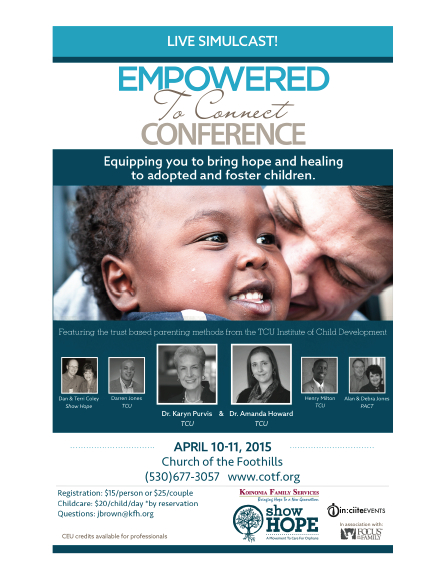
 The Attach Place provides a monthly no fee Trust-based Adoptive Parent Support Group in Sacramento, every 2nd Wednesday of each month. Next group is April 8th. Come join us. Online RSVP each month required. Child care provided.
View original post 9 more words
Sometimes as parents of hurting kids we get confused, angry or just exhausted. As we run the gauntlet of emotions and hurt and pain – for both our child and us – burn out happens.
Sometimes we believe the child would be better off living elsewhere. Nothing we can do is helping him or her. No amount of consequencing, love or effort is paying off or changing anything for or with our kids. It then feels to us like a waste of time. Life is just a roller coaster of hurt and disappointment.
But – we MUST remember – it is our job to give these kids they tools they need to become productive, caring and responsible adults. It’s not our job to do all the work. That is something they must choose for themselves we can only help them by putting opportunities in their life.
We are not in the position to stop them making every choice they make or acting ugly rather than ask for help because they are struggling today. But we can try to teach with what we have in us. No more and no less. Some days we may have the energy and some we might not – it’s OK!
It’s also OK to say I lost it with my child today. I said hurtful things. I Feel like a terrible person for not being ‘adult’ enough to not stay cool, calm and collected.
We are in our own home and locked in battle with these kids we love so much. But their pain is used as a weapon against us. That would push anyone to not always stay in a loving and calm place – anyone! We are human!!
Another parent posted some amazing advice to help us get through – thank you K!! ❤
for me, I had to just put my hands in the air – and walk away from trying to have that dream of being her mom (in the sense that I wanted to be – a real mom, a mom who loved her more than anything).
I had to stop striving to have that mother/daughter relationship I had assumed (naively) that we would have… the things I wanted to give to her, that my mom gave to me. That had to be packed away in a snug little box… and put up on the shelf.
Then I had to put my therapist hat on. Because that I could do without getting my feelings hurt.
It’s all mental,.. You can only get hurt when you let yourself, right? So I had to stop looking at my daughter as J my daughter…. and start looking at her as a child who was trapped by RAD – as if she were in a cage… and my job was to help her figure out how to get out of it. ALL MENTAL IMAGING for sure.
This way – my heart was out of the picture.
That said – I had to do a lot of faking. I hate to say that, but it’s true — and I had to fake through a lot of stuff if I was going to save her life. So while that may sound deceitful – I was in a fight for her life… I had to force myself to hug her when she was at her worst….. I had to look her in the eye with soft eyes, soft face, and with soft words say “I love you no matter what.” Hardest thing I’ve ever done, because it feels like a lie (at the time). But it turned out to be my OWN therapy, really.. because “me” started to come back.. I started to be able to bury all the anger and feelings of rejection when I looked at the whole big picture from the perspective of an EMT saving someone’s life. A rescuer. The love then comes.. or at least some semblance of it..
I had to ask myself – why is it that I can have such pity for abused dogs that bite and attack … and feel such empathy for them being how they were through no fault of their own, but I could not have that empathy for my own daughter.
Using imagery to help your mind and heart cope with the rejection and chaos really does help. Take the mom hat off, with all it’s hopes and dreams…. and put on the Therapeutic Mom hat… and try to save a life.
If you don’t succeed – at least you tried. If you do succeed – you can take that box off the shelf, and be mom again. 🙂
Reactive Attachment Disorder, trauma and pain only taught our children that adults could hurt and abandon. It taught them hurt and pain. In the earliest years they know nothing but pain. Few smiles Of happiness only fear, anguish and so bleak.
It sometimes taught them no one was there while they lay in a hospital in pain.
It sometimes taught them no one cared even if mommy loved them dear. They just didn’t feel it – so to them it wasn’t there.
For others they felt It with a slap, shove or kick. As they landed on the floor withering in sobs. Their abuser looks on and simply huffs and walks on.
For others the screams haunt them In the night. Or the visitor that comes to them each and every night. Hurting them and doing things well Out of sight.
Our kids locked in misery, trouble and pain. Fear is their master and the tasks it does set……leads them to protect their hearts so as to never forget.
High are the walls Around their little hearts. High oh so high as they vow – never again.
When they enter new families their pain they still hold. Close to their hearts the pain will start to unfold.
Loving is not something they know or want to believe. Could an adult not hurt them? They won’t try to find out. Not now.
Hurt and anger is what they know best. Hold on to it now and put these new adults to the test.
What are they doing? Why do they care? I don’t understand this it makes no sense. Why are they not hurting me and tossing me aside.
It causes confusions and fear to enrage. They don’t understand it so war has been waged.
Keep on loving me I need it so bad. Try to remember I feel so terribly bad. This fear is a tough master but with your love, maybe one day I can become whole one day.
~ Elly
~ Flashbacks: A sign of healing
A young 16 year old girl had a seriously traumatic and destructive event happen recently.
On speaking to a therapist I shared that the flashbacks were scaring the life out of the girl. They were happening constantly.
The girl saw the victimisers face appear all the time, and was dreaming about him and the events.
Therapists response to flashbacks: They are a healthy and positive step forward!
Flashbacks are a positive sign that the mind is starting to process the trauma and pain. The emotions are starting to deal with the event.
This is a good thing because when flashbacks or emotions are shut down, this means the pain and trauma is buried very deep inside and can’t be dealt with or processed in that state. Healing can’t occur when strong and painful emotions are not brought to the surface.
Next time your child has a flashback: please do not be afraid of it. This is a sign they feel safe enough with you to process their pain.
Each time a child acts in anger, this too is a positive sign of starting the journey to healing (frustrating & exhausting for parents!).
Expressing anger and pain shows At some level they feel safe enough to work through their anger and pain with us.
I was also reminded that there was NOTHING I could say to the girl to make her situation worse. The worst had happened and she had survived it.
~ Elly


